Korean Researchers Turn Wet Coffee Grounds Into Biochar in 90 Seconds
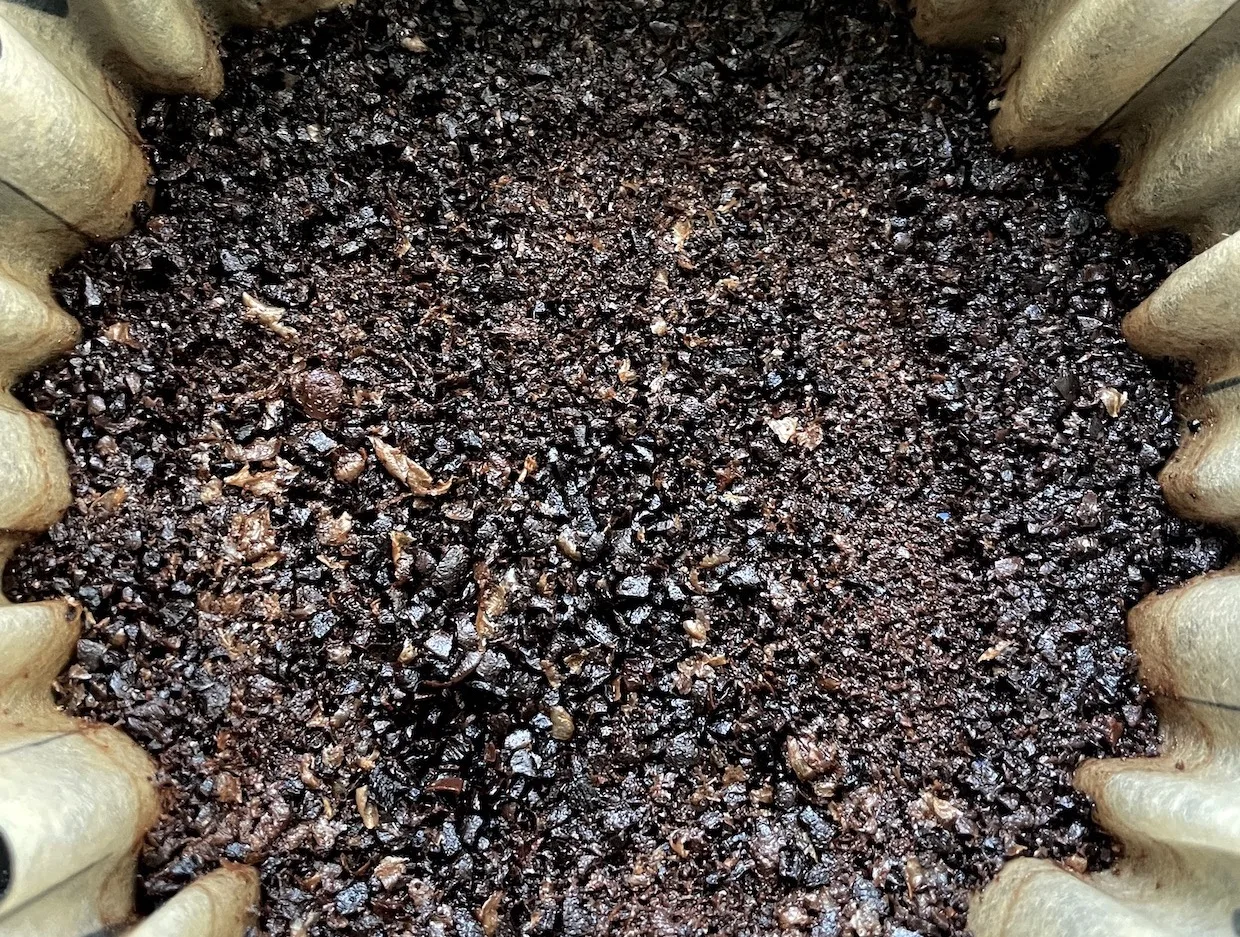
Daily Coffee News Staff| August 3, 2026 A basket of moist coffee grounds. Researchers in South Korea say they’ve developed a new process that can convert moist spent coffee grounds into biochar in 90 seconds. The researchers are promoting the process, tested at a lab scale as opposed to a commercial scale, as a potential pathway to convert a portion of the millions of tons of coffee grounds generated globally each year into a usable fuel source. “This technology presents a new paradigm in which waste is no longer viewed as a disposal problem but as a valuable energy resource,” Taejun Park, lead author of the study, said in an announcement of thepublication inChemical Engineering Journal. “We plan to expand the technology to various types of high-moisture organic waste and further optimize the process for industrial-scale commercialization.” The researchers note that fresh spent coffee grounds typically have high moisture content, which adds time and costs to conventional conversion processes by requiring extensive pre-drying and other intensive operations. The lab-tested grounds had roughly 55% moisture content. The technology they employed to create the biochar, called flame plasma pyrolysis (FPP), was developed by researchers at theKorea Institute of Geoscience and Mineral Resources(KIGAM). According to the researchers, when the plasma flame hits wet coffee grounds, the intense heat vaporizes the internal moisture almost instantly. That creates a rapid buildup of pressure inside each particle, triggering what they call the “popcorn effect” — tiny internal explosions that open pores throughout the material. The moisture, rather than being a barrier to conversion, becomes what the authors describe as “an in-situ steam activation agent,” simultaneously driving carbonization and creating biochar’s highly porous structure. “The researchers emphasize that the ability to directly process wet feedstocks without pre-drying represents one of the most significant economic and environmental advantages
Daily Coffee News Staff| August 3, 2026 A basket of moist coffee grounds.
Tech news moves quickly enough that any single story is best read as one data point in a longer arc. The products change, the companies shuffle, but the underlying patterns — incentives, supply chains, regulatory lag — tend to repeat.
The most useful frame for reading coverage like this is to ask what would have to be true for the announcement to matter in a year. Most of the time, the honest answer is "not much." Occasionally, the answer is "everything," and those are the stories worth following up on.
We will keep tracking this one as it develops. If the details shift materially, we will update this piece rather than publish a follow-up that contradicts it.